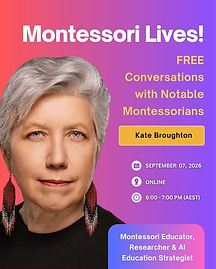
KATE BROUGHTON
About Me
Kate Broughton, M.Ed., is an educator, researcher, and strategic advisor working at the intersection of Montessori education, artificial intelligence, and the future of learning. With over 40 years of experience across the UK state system and US private Montessori schools, she has spent her life committed to the transformation of education by following each unique child. She currently advises the ZSchool Strategic AI Program at the University of San Francisco, working with business and education leaders on responsible, human-centered AI adoption.
In 2007, Kate co-founded Kingwood Montessori School in Texas (US), was upper elementary lead, and then led as director until 2020, co-creating a nurturing and vibrant learning environment rooted in developmental theory and child-centered pedagogy. Since then, her journey has taken her into the heart of educational innovation. As a two-time fellow with the Innovation Fellowship Think Tank initiated by the American Montessori Society, she initiated award-winning research into how Montessori education naturally aligns with digital citizenship and AI competency development, and led an expert team to create Innovation Lab: The Future Montessori Classroom for the AMS 65th Anniversary Exhibit at The Montessori Event in Denver in March 2025, work recognized with the AMS Impact Medal. The exhibit demonstrated a pathway to inviting technology and artificial intelligence thoughtfully into the Montessori environment.
In March 2026, Kate and Michelle Velho, M.S., presented UNBOUND: Mapping, Flow, and the Future of Montessori in the Age of AI at The Montessori Event in Washington, D.C., exploring the intersection of Montessori education, human development, and the future of artificial intelligence. That same week, Kate carried her Assessment Credibility Plan to Washington, meeting with congressional offices to present a four-document policy suite, including a five-year assessment transition timeline and a legislative brief. At its center is the Evidence Stack, a six-layer, human-first assessment model built to answer a defining question of this decade: how education systems can credibly assess thinking, judgment, and understanding in a world where AI can generate any type of content.
In 2026, Kate published two foundational documents now available through this site. A Cosmic Story: The Coming of Technology, co-authored with Aishwarya Sankaranarayanan, extends Montessori Cosmic Education into the age of intelligent machines for children in the elementary years, published in both Teacher's and Read Aloud editions. The Montessori Rights of the Child, an articulation for the age of intelligent machines, is a five-article declaration of what every child is owed in a world of persuasive technology, published on Dr. Maria Montessori's 156th birthday.

Innovation Lab: The Future Montessori Classroom
This Exhibition Padlet was shared at the AMS 65th Anniversary Event by the Technology Group Team Members: Debbie Adams, Dana Anderson, Pat Barton, Kate Broughton, Sam Gleisten, Aishwarya Sankaranarayanan, Shelley Smith, Ronke Okesola, Katie Torres, Michelle Velho, Mara Weitzman. You will also find other powerful content from Desislava Stoeva, Kim Smith Claudel, Sarah Kennedy-Berge, and Nancye Blair Black, and others.
Why Me, Why Now?
What drives me is a deep belief that the future must be built on hands-on experiences in the real world, cultivating agency, autonomy, integrity, and intentional design.
As educators, we are not merely preparing children for the world; they are already shaping it, every day, in how they see, question, and respond to it. Our role is to work alongside them, with clarity, humanity, and imagination, holding space for them to engage fully with complexity, purpose, and possibility.
I believe learning should be lived, not simulated. That creativity and critical thinking are not separate from moral development but deeply intertwined. That the classroom is not a container, but a launchpad.
And I believe the systems we build now, educational, technological, ethical, must reflect the dignity of the children who will inherit them.
This is not a time for reform, and it is not a time to invent something new. The design already exists. For more than a hundred years, Montessori education has proven, in classrooms across every continent, what children can do when they are trusted with meaningful work. What this moment asks of us is not redesign but recognition, the will to let a proven pedagogy lead.
For trusting in the intelligence of children, the relational wisdom of teachers, and the power of environments that invite meaningful work.
Education is not preparation for life. It is how we live, together, in real time, as we build the future.
So, maybe it is time to ask the question, Why You, Why Now?
Media